Natural stone is one of the oldest building materials there is, but its modern supply chain carries real risks: water use in cutting, energy in processing, dust and safety in the quarries, and labour conditions that vary from region to region. BlokPort sets a clear, documented compliance floor for every supply partner, checks it independently, and points European buyers only to material that meets it. As a company, BlokPort also works to a full, published set of governance, ethics, human rights and environmental policies, laid out below. This framework is meant to be audited, not admired.
These are BlokPort’s own company policies, separate from what we ask of supply partners further down. Each one has a named owner, a version history and is open for you to read, and together they make up the documentation pack procurement and ESG teams usually ask us for.
Sustainability and compliance sit directly with BlokPort’s founder and management, not off to one side in a separate team. The policies above are owned at that level, reviewed on a set schedule, and shared with any buyer who asks. Independent ratings and our corporate carbon programme are still in progress, and we set them out honestly in the commitments below.

Before a partner ships a single bundle, we check these five certifications directly with the body that issued them. Each covers a specific scope and is renewed at set intervals by an accredited authority.
Documented environmental policy, impact tracking, legal compliance and continuous improvement at every production site in scope.
Accredited certification bodiesDocumented quality processes, traceability from block to bundle, defined corrective action and systematic management review.
Accredited certification bodiesMandatory framework for products placed on the EU market: declared performance, traceability and conformity assessment.
European CommissionConformity under EN 12057, EN 12058, EN 1469 and related standards for tiles, slabs and dimension natural stone in the EEA.
Notified bodiesIndependent audit by SGS, Bureau Veritas, TÜV or equivalent covering capacity, working conditions and documentation integrity.
Independent auditorsSmaller producers and partners in developing markets can join under a documented improvement plan while they work toward a floor certification. We flag their status on the platform and keep their listings limited until they fully conform. We make no exception on ISO 14001 or EU CPR.
We treat this as an ongoing process, not a single check at signing. Every partner goes through the four stages below for as long as they stay on the platform.

BlokPort maps the Greenhouse Gas Protocol scopes onto the trade flow it manages, and captures data you can carry straight into your own carbon accounting and CSRD/CSDDD reporting. We do not issue verified emissions statements ourselves. The verified figures come from partners’ ISO 14001 reporting and carriers’ published disclosures.
Sources the partner owns or controls on site: cutting-line fuel, forklifts, on-site generators and heating. The partner reports these under ISO 14001.
Indirect emissions from purchased electricity at the processing plant. Grid mix and any on-site renewable generation are recorded at onboarding and updated annually.
Upstream quarrying inputs, downstream ocean and inland freight, packaging and end-of-life. The largest single category for natural stone is ocean freight.
Buyers above the thresholds disclose double materiality, value-chain emissions and supplier policies. The documentation pack and Scope 3 data feed this directly.
Mandatory human-rights and environmental due diligence in supply chains. The labour, modern-slavery and grievance commitments are structured to meet its evidence requirements.
Carbon Border Adjustment currently covers cement, iron, steel, aluminium and others. Natural stone is not in scope today, but the mechanism is under review and the framework is ready for inclusion.
Greenhouse-gas intensity limits on vessels above 5,000 GT calling at EU ports. Applied by carriers on the route and recorded in the documentation pack.
Maritime emissions inside the EU Emissions Trading System. Carriers pass the cost through; the declared coverage is recorded in the shipment file.
The CE Declaration of Performance is part of the floor and travels with every shipment.

Under the ISO 14001 framework, each partner reports against the categories below. BlokPort records what they report, the supplier’s own attested and audited measurements, and shares it with buyers on request.
Grid mix at the production site and any on-site renewable generation. Rooftop solar PV is increasingly common in Brazil, Türkiye and India.
15–60% renewable where on-site solar is installed.
Material yield from block to finished slab. Multi-wire diamond saws achieve substantially better yield than older gang saws.
92–97% yield on multi-wire saws.
Wet-cutting protocols, dust extraction and worker PPE policy on processing lines, reviewed during third-party audits.
Wet cutting standard across all admitted partners.
Site-restoration obligations attached to the quarrying licence and the partner’s progress against them.
Licence terms + restoration progress recorded.
Topsoil management, run-off controls and land-use change at extraction sites, against the Environmental Impact Assessment.
Recorded at onboarding, reviewed on inspection.
Every figure here is the partner’s own ISO 14001-audited measurement, and we share it with buyers on request.
Cutting and polishing is water-intensive, so water is treated as a distinct category. Stress varies sharply by origin region and is increasingly material under the EU Taxonomy and CSRD.
Closed-loop systems recycle the majority of process water rather than discharging it. Most onboarded processing partners report 80–95% recycling, partner-attested and audited under ISO 14001.
Fines and silica recovered from process water are filtered, settled and dewatered, then reused as aggregate, processed for industrial use, or disposed of under a hazardous-waste licence where required.
Any externally discharged water is subject to the partner’s local permit, with quality monitored against permit limits and reported under the ISO 14001 system.
Where a partner operates in a region classified as high or extremely high water stress by the WRI Aqueduct framework, additional reporting is required: groundwater versus municipal source mix, total annual withdrawal, and any community water-sharing arrangements. These are recorded and disclosed to buyers on request.
Natural stone produces significant offcut volumes even on modern saws. The framework records how each partner manages offcut and packaging waste, prioritising recovery and reuse over landfill.
Recovered into smaller-format tiles, mosaic, paving, terrazzo or crushed aggregate for construction fill. Landfill is last resort.
Annual offcut tonnage + recovery rate.
Dewatered and reused as cement or aggregate input, used in brick production, or disposed under licence.
Sludge volume, destination, end-use.
Reused where shipment cycles permit, otherwise recycled into chipboard or biomass. ISPM 15 heat-treatment required for international movement.
ISPM 15 certificate per shipment.
Strapping, foam edge protection and shrink wrap recovered into recycling streams where destination infrastructure exists.
Packaging type + weight per bundle.
Natural stone is durable and reusable, so it can be reclaimed and resold rather than crushed when a building comes down.
Original material specification recorded.
Recovery and reuse come before landfill at every step of the chain.
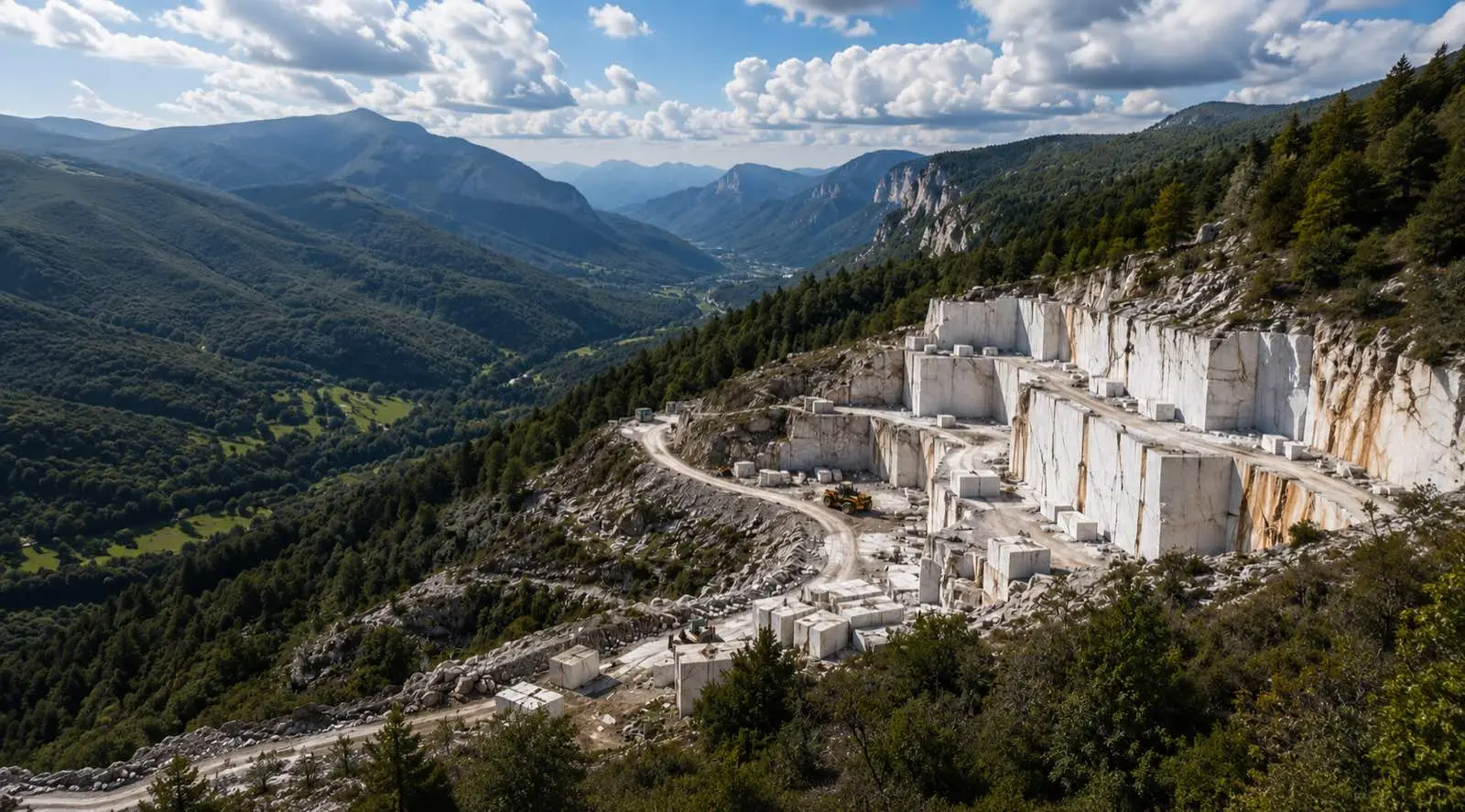
Extraction is, at heart, a land-use activity. We screen every quarry we onboard against recognised biodiversity data, and we control outbound freight and crating so they do not carry invasive species into the ecosystems they arrive in.
Every quarry partner is screened at onboarding via the Integrated Biodiversity Assessment Tool for proximity to Key Biodiversity Areas, Ramsar wetlands and UNESCO natural sites. Partners in sensitivity buffers provide their EIA and any Biodiversity Action Plan.
Vessels calling at routed ports comply with the IMO Ballast Water Management Convention (D-2) and biofouling guidelines. Compliance is the carrier’s obligation; the declaration is recorded in the shipment file.
All wooden crating and dunnage is heat-treated and stamped to ISPM 15, the global protocol for preventing pest spread through wood packaging. No untreated timber is permitted in routed shipments.
Labour conditions matter more and more under the EU CSDDD, the UK Modern Slavery Act, the Australian Modern Slavery Act, the German Lieferkettengesetz and the Norwegian Transparency Act. We built the floor to meet the evidence requirements of all five.
The labour and grievance commitments support buyers’ obligations under the EU CSDDD, the UK Modern Slavery Act 2015, the Australian Modern Slavery Act 2018, the German Lieferkettengesetz and the Norwegian Transparency Act. The documentation pack travelling with each order is structured to provide audit-ready evidence under all five.

Everything below is committed but not yet in place. We list these as intentions rather than pretend we already hold them, so this page stays honest. We confirm target dates as each programme is scoped.
An independent sustainability scorecard across environment, labour and human rights, ethics and procurement, widely used by corporate buyers.
Ethical-trade membership and a SMETA audit covering labour, health and safety, environment and business ethics.
Environmental disclosure on climate and water for buyers and investors, aligned with TCFD and CSRD.
Signatory to the ten principles on human rights, labour, environment and anti-corruption, with an annual Communication on Progress.
Structured reporting aligned to recognised frameworks (GRI, SASB, TCFD, CSRD-ESRS) as the programme matures.
Measurement of BlokPort's own Scope 1 and 2 emissions, and Scope 3 where feasible.
A defined reduction pathway set once the footprint baseline is measured.
Validation of the reduction target against climate science.
Independently verified lifecycle data per product, supporting BREEAM MAT credits and LEED.
Third-party responsible-sourcing certification for construction products, recognised by BREEAM.
Documentation prepared to contribute credits to the major building-assessment schemes.
Per-product embodied and whole-life carbon figures for specifiers.
A defined programme of investment in the regions our supply partners operate in.
Ocean freight is the biggest single source of emissions in the international natural stone trade, and no platform changes that fact. What routing through BlokPort does change is the shipping intensity per square metre delivered, which it measurably reduces in four ways.
Issued by the chamber of commerce or equivalent authority in the country of production.
Itemised per bundle with full dimensions, weight and customs codes.
Phytosanitary certificate where required, plus the ISPM 15 heat-treatment stamp on all wooden crating.
Under EU CPR 305/2011 for slabs, tiles and dimension natural stone placed on the EEA market.
Time-stamped photographs of bundle preparation, crating and container loading at the facility.
Negotiable bill of lading from the carrier and a marine insurance certificate covering the consignment door to door.
Carrier declaration of FuelEU Maritime compliance and EU ETS coverage for the voyage where applicable.
Current ISO 14001, ISO 9001, EU CPR conformity, CE Declaration and the most recent third-party audit report.

BlokPort has no green, blue or sustainability-linked debt in issuance. Any future instrument would be issued under the ICMA Green Bond Principles or Sustainability-Linked Bond Principles, with use of proceeds and KPIs aligned to the EU Taxonomy where applicable: plausibly clean transportation (consolidated low-emission freight) and circular economy (offcut recovery). The framework will be updated when, and only when, an instrument is actually issued.
A compliance framework is only as credible as it is clear about what sits outside its scope.

The framework is documented in full, and you are welcome to review it before we do any business together. We welcome the scrutiny, the more people look at it from the outside, the stronger it gets. Procurement teams can take our full policy suite and compliance documentation as a single pack. First conversations are confidential and commit you to nothing.